
Reading an Ottawa County Release
A person leaves Ottawa County custody when the Sheriff's legal authority to hold that person ends or when another agency assumes the hold. Those outcomes are not the same. Bond, personal recognizance, time served, completion of a jail sentence, dismissal, and a court order may return someone to the community. A transfer to the Michigan Department of Corrections, another county, federal authority, or immigration custody changes the custodian without ending confinement.
The Ottawa County Sheriff's Office public lookup is a live roster. It does not retain a public released-person row. After a person leaves the jail, the booking and release record remains with OCSO, while the 58th District Court or 20th Circuit Court retains the legal case record. A person sent to state prison should later appear in the Michigan Department of Corrections Offender Tracking Information System, known as OTIS. A parolee remains under MDOC jurisdiction until discharge.
Ottawa County Release Types and Destinations
The release disposition and receiving authority give meaning to a departure. Ask for the words used in the actual jail-management record instead of changing every outcome to “freed.” The court file can explain the authority, but the Sheriff's timestamp is the better evidence of when physical processing ended.
| Custody outcome | What it means | Best next record |
|---|---|---|
| Bond or recognizance | The person leaves local custody while the criminal case continues. | OCSO release entry and court bond order |
| Time served or sentence complete | The jail portion has been satisfied, though probation or another case may remain. | Release entry and judgment of sentence |
| Court order or dismissal | A judge or case result supplies legal authority to end the hold. | Court order plus jail release time |
| Transfer to MDOC | Ottawa custody ends but state confinement begins or continues. | OCSO transfer disposition and later OTIS record |
| Parole | A state prisoner leaves a secure setting but stays under MDOC supervision. | OTIS status, Date Paroled, and assigned office |
| Other agency hold | Another county, USMS, ICE, or another authority takes custody. | Transfer destination and receiving-agency record |
Probation is different again. It can be imposed as a community sentence without a prison stay. Ottawa district-court probation is handled through the 58th District Court, while felony probation and parole fall under MDOC. A final discharge ends the applicable supervision term; it should not be confused with the earlier date a person walked out of jail or prison.
How Bond Releases Work at Ottawa County Jail
Ottawa County distinguishes cash, ten-percent, and surety bonds. The Sheriff's account page identifies the jail lobby eXpress Command kiosk, the ExpressAccount website, and 866-422-6833 as payment channels, with vendor fees that can vary. Some minor matters may use a standard bond, while a judge must set bond in more serious matters. Payment alone does not prove departure because all holds and release conditions must clear.
A bond release leaves the case pending. It is not an acquittal, dismissal, or completed sentence. Verify the bond event in the 58th District Court record, then obtain the OCSO release timestamp and disposition. A receipt shows a transaction; the release entry shows what Ottawa County did with the hold.
Note: Use the court and jail records together when the bond order and physical departure occurred at different times.
Fields in an Ottawa County Release Record
A focused record request ties the event to one booking and asks the custodian to produce existing fields. The responsive record may differ by case, system, and lawful redaction, so the list below is request language rather than a promise that every item will be disclosed.
| Booking identity | Booking number, full booked name, aliases, and admission date and time connect the release to the right jail stay. |
|---|---|
| Arrest and case | Arresting or holding agency, charges, court, and case number explain which matter supported custody. |
| Bond and holds | Bond fields and hold agencies show conditions or another authority that may affect departure. |
| Custody movement | Housing and transfer entries can distinguish internal movement from a true release or transfer out. |
| Release event | Release date, time, authority, and disposition or reason state when and why Ottawa's hold ended. |
| Receiving authority | A public transfer destination can show that custody continued elsewhere. |
| Booking photograph | The admission image must be requested as a separate responsive item when it is needed. |
MiCOURT can add the legal story: arraignment, bond changes, dismissal, plea or verdict, sentence, jail credit, probation, and later orders. Yet the online docket is informational, and a judgment does not always capture the hour that release staff finished processing. Ask the clerk for the official order when an abbreviated docket entry is unclear.
Request an Ottawa County Release Record
Ottawa County accepts electronic requests through its FOIA Center. Written requests may also go to the Sheriff's Records Unit by fax, mail, or in person. The office states that a report will not be ready at the moment of a walk-in request, so identify the record before visiting.
- Give the complete booked name and, if known, date of birth, booking number, and approximate admission date.
- Ask for booking time, arresting and holding agencies, case identifiers, bond fields, release date and time, release disposition, authority, and any public transfer destination.
- Request the front-view booking photograph separately if it is necessary to identify the booking.
- Prefer electronic delivery and ask for an itemized estimate before work that may create a larger fee.
- Keep the agency response with the court order or VINE event used to corroborate it.
Michigan FOIA provides a general five-business-day response period. The response can grant or deny the request, seek clarification, give payment instructions, or invoke one ten-business-day extension. OCSO says actual work controls the cost and many requests are under $10, but it cannot quote a particular request by phone. That statement is not a fee guarantee.
The Ottawa FOIA portal opens with registration and request controls shown below. The screen helps locate the electronic channel; it does not itself contain a release record.
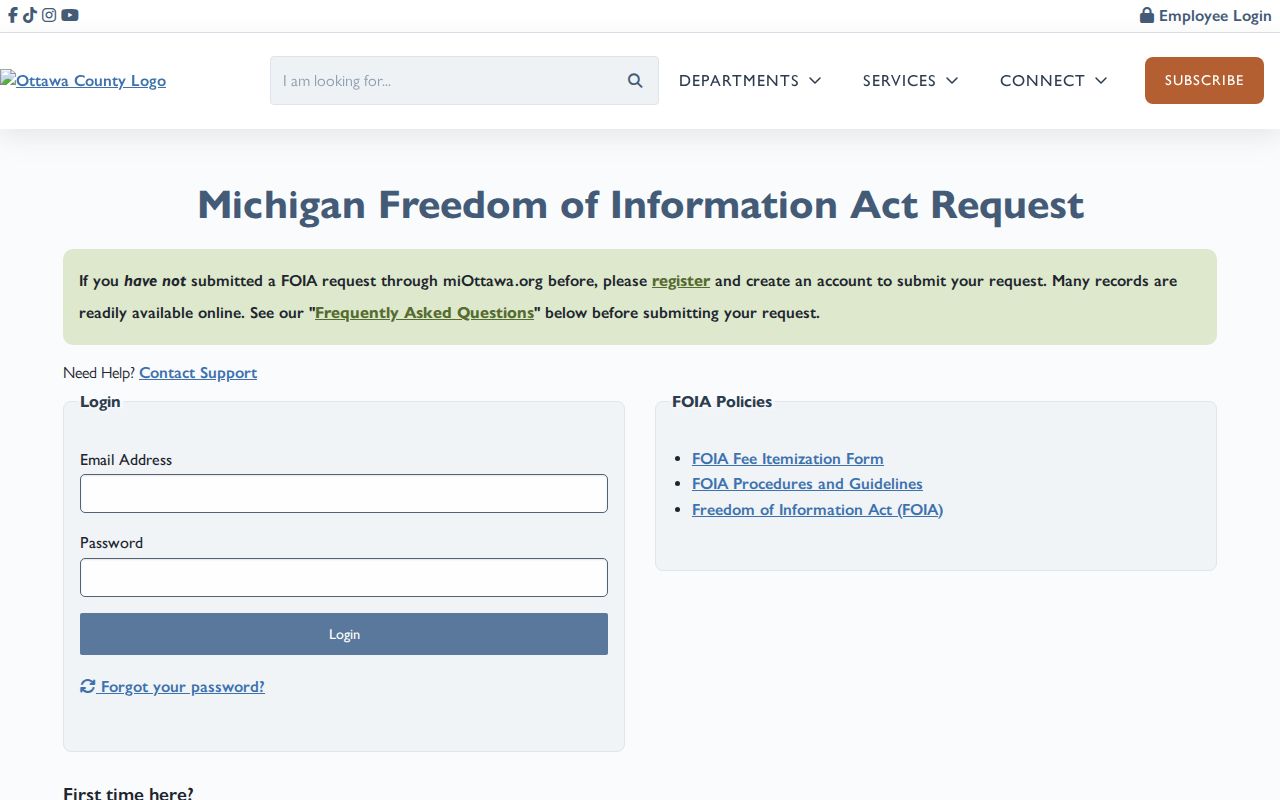
Once submitted, the request travels to the county record custodian, who determines which existing jail records are responsive and which lawful redactions apply.
Ottawa County Sheriff's Records Unit
12220 Fillmore Street
West Olive, MI 49460
616-738-4000
FOIA questions: 616-738-4025 or 616-738-4094
Fax: 616-738-4062
Ottawa County Release Records and Michigan FOIA
Michigan's Freedom of Information Act, MCL 15.231 through 15.246, supports access to records of official acts while preserving statutory exemptions. MCL 15.235 sets the response framework, MCL 15.234 addresses permitted fees and deposits, and MCL 15.243 lists exemptions. FOIA does not require an office to create a narrative, answer a question, or certify a guess. That is why a request should name the existing booking and release fields.
Retention and public web display are separate. Michigan General Schedule 11 lists minimum county-law-enforcement retention periods, including calendar year plus seven years for booking or control-center logs and calendar year plus one for daily count summaries. Ottawa's current roster still offers no historical display. Request the identified record promptly instead of treating a retention schedule as an online access promise.
Juvenile, sealed, protected, medical, and security-sensitive information may be unavailable or redacted. A set-aside under MCL 780.621 and related Clean Slate provisions can make qualifying conviction information nonpublic. Current official sources should govern; stale copies elsewhere do not defeat a lawful change in public access.
Why Ottawa County Release Records Outlast the Roster
OCSO reported 4,527 bookings and 4,523 releases during 2024, while average daily population was 269. The contrast explains the roster's limits. Thousands of custody events can pass through the Ottawa County Jail in one year even though the public interface shows only the smaller group held at the moment of a search.
Those aggregate figures do not identify any person or prove a particular release. They show why a current snapshot cannot replace a named booking/release entry, court order, or custody-change notice.
Money and Property After Ottawa County Release
The Sheriff's commissary and account guidance describes two Ottawa-specific departure details. A remaining inmate-account balance is issued on a debit card at release. An unclaimed commissary order becomes Sheriff property seven days after release. Neither fact establishes that another hold cleared, but each may help explain what should have happened during processing.
When an account or property handoff is disputed, ask for the existing release-account or property documentation, if retained and disclosable. State the booking and departure date. Do not ask the records office to reconstruct events from memory when a transaction or property log may already exist.
Find a Released Ottawa County Inmate
Start with custody scope, not a broad name search. A recent Ottawa County Jail stay belongs with OCSO. A prison sentence or active felony supervision belongs with MDOC. A federal prison sentence belongs with BOP, while immigration detention belongs with ICE. Court records explain the legal case across those transitions.
- Search the OCSO current inmate lookup with the complete last name and optional first name, booking date, and gender. A result means current custody, subject to the county's timing warning.
- If no result appears, note the search time and check the Ottawa case in MiCOURT for a bond, dismissal, sentence, or transfer order.
- Check the exact person in MI-VINE for an agency-supplied custody event. Use the event as corroboration, not a certified archive.
- For an MDOC sentence, search OTIS by MDOC number when possible and read status, location, Earliest Release Date, Date Paroled, and Maximum Discharge Date in context.
- For federal or immigration custody, use the BOP locator, federal court or USMS channel, or ICE Online Detainee Locator as the case requires.
- Request the OCSO release record when the exact time, disposition, authority, or transfer destination matters.
Ottawa's current-custody search plainly states its limited scope, as this captured interface shows.
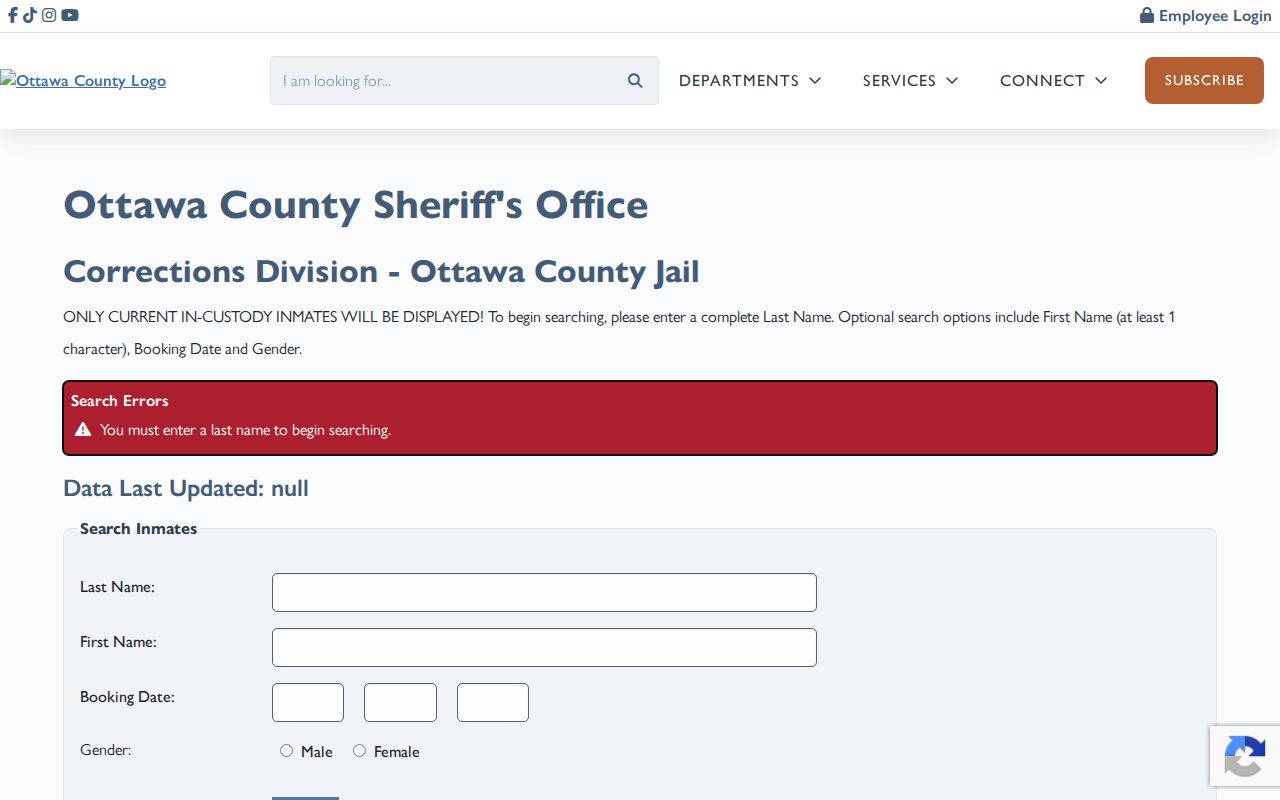
The form is useful for deciding whether someone is displayed now. Its empty result cannot supply a release date, a reason, or proof of return to the community.
Which Ottawa Court Record Tracks Release?
Every Ottawa criminal matter begins in the 58th District Court. Misdemeanors remain there, while a felony moves to the 20th Circuit Court after preliminary examination or waiver. A person may therefore have useful entries in both dockets. Search by case number when possible, read the chronology, and obtain the judgment or release-related order from the clerk if the summary is abbreviated.
The Michigan MiCOURT Case Search provides court, case-type, participant, and case-number controls.
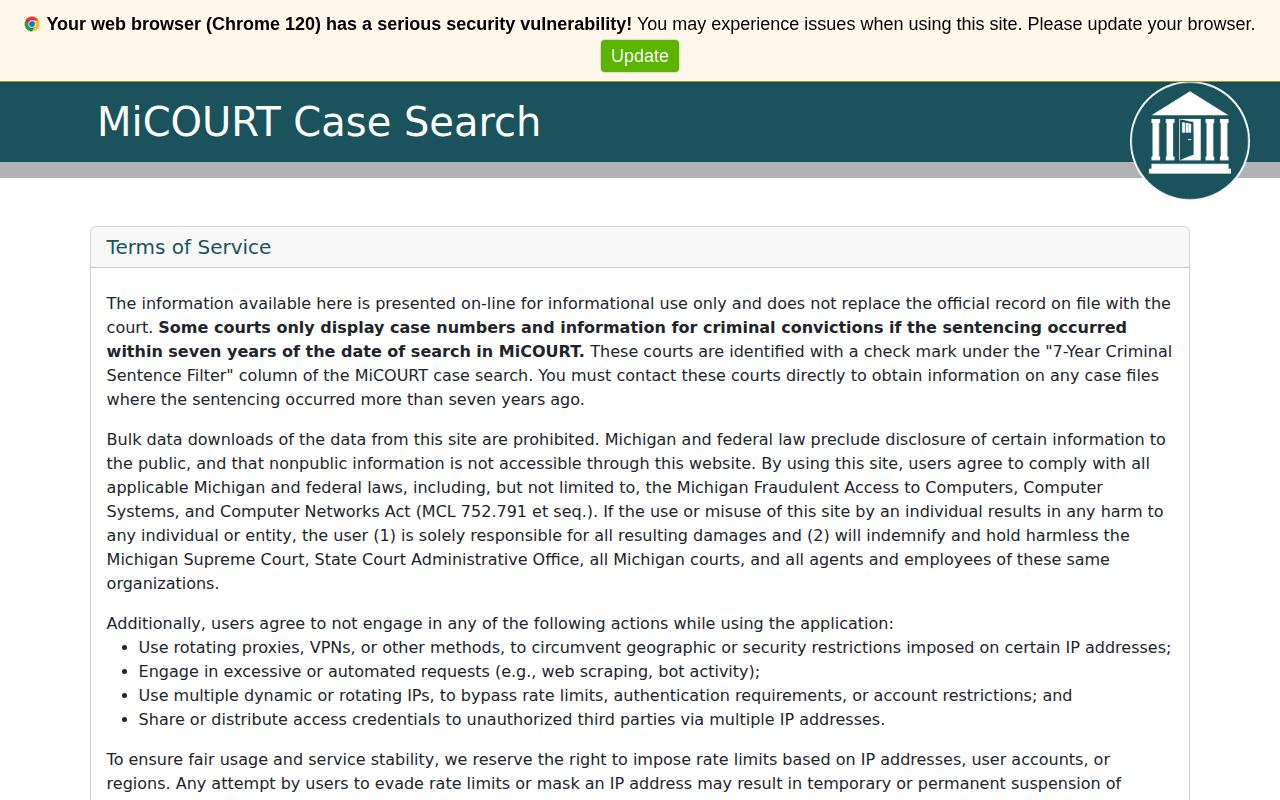
MiCOURT can connect bond, dismissal, sentence, jail credit, or probation to the custody timeline, but OCSO still holds the physical release entry for an Ottawa jail departure.
MDOC Search for Ottawa County Released Inmates
OTIS is the right state system for someone sentenced from Ottawa County to an MDOC prison, even though no operating state prison was identified inside the county. It includes current prisoners, parolees, probationers under MDOC supervision, and discharged persons still within three years of supervision discharge. It excludes jail-only sentences, municipal lockups, people not yet sentenced, exempt information, and those outside its public display window.
| MDOC number and name | Use the number when known; it is more reliable than a same-name match. |
|---|---|
| Current status | Distinguishes prison, parole, active supervision, absconder, or discharge wording. |
| Supervision location | Identifies the assigned field office rather than merely the nearest office. |
| Earliest Release Date | Marks minimum-based parole eligibility, not a guaranteed exit. |
| Date Paroled | Shows when parole began and is stronger evidence of actual departure from prison. |
| Maximum Discharge Date | Shows the outer sentence date on the controlling sentence, subject to lawful computation. |
The MDOC OTIS overview explains that limited scope, which is visible in the captured agency page below.
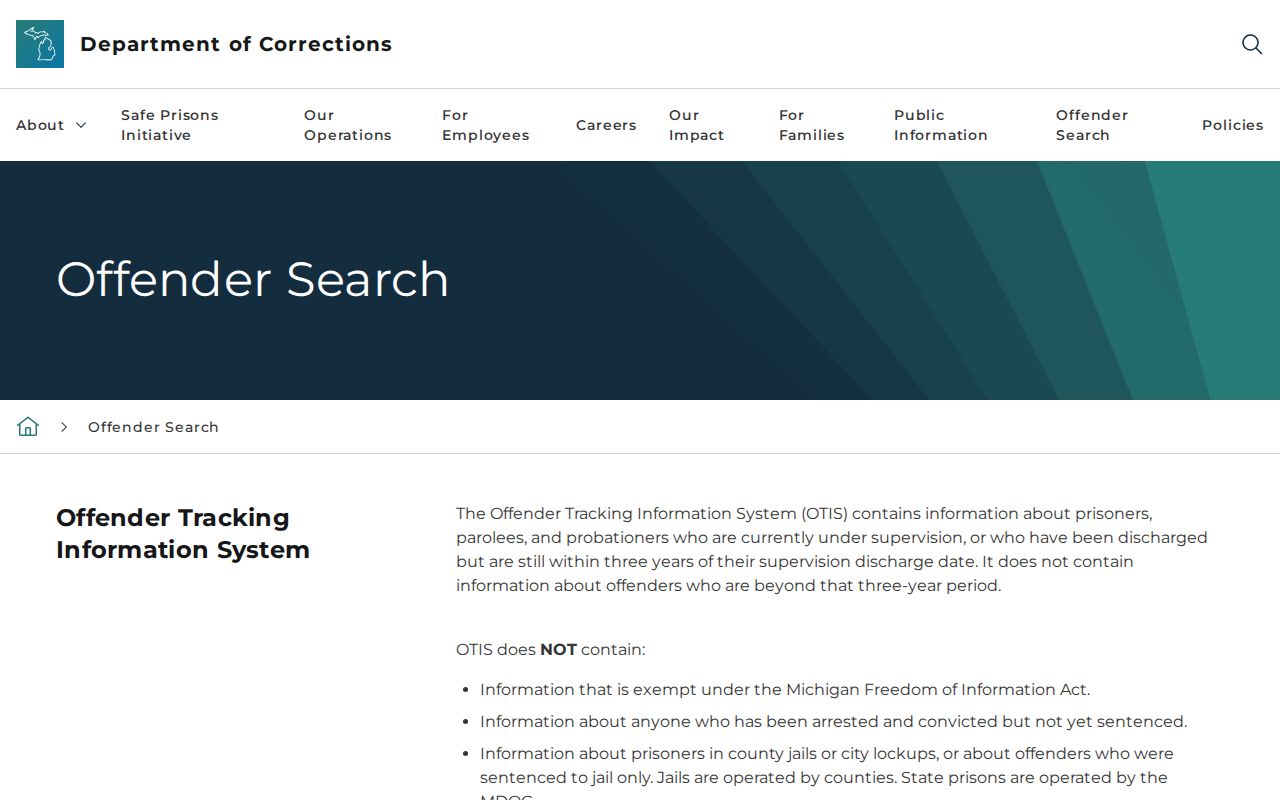
Read the status and date fields together. Earliest Release Date is not proof that the Parole Board acted, while Date Paroled or a supervision discharge entry records a later, actual status change.
No Ottawa County Recent-Release Feed
OCSO publishes no separate official rolling 24-hour or 72-hour release view in the reviewed jail navigation and application. The current roster has no released-status filter, public archive, release cadence, or retained released row. An on-screen “Data Last Updated” value can timestamp the snapshot when it works, but it is not a promised service schedule.
For a named person, the practical fallback is current-custody exclusion, MI-VINE, the court docket, a call to 616-738-4650, and a focused FOIA request. The wider Ottawa County 24-Hour Releases guide explains this no-feed problem without substituting an unofficial arrest site.
Ottawa County Supervision After Release
Parole and felony probation can appear in OTIS while active. Open the individual record, verify status and Date Paroled where applicable, and use the assigned supervision location to find the correct MDOC field office. Ottawa-area MDOC offices are listed in Grand Haven, Hudsonville, and Holland, but proximity does not determine assignment.
The 58th District Court separately operates probation and Community Corrections for district matters. Its general mailbox is dc.probation@miottawa.org. A district probation record may not appear in OTIS. An OTIS absconder label describes a supervision issue, not a new conviction or proof of current Ottawa jail custody. The Ottawa County post-release supervision page separates these channels and explains verification.
Ottawa Release Alerts and Federal Locators
Ottawa's jail page promotes MI-VINE for release notifications. Register on the exact person's record while the record is available, select an offered custody event and contact method, complete the current confirmation steps, and retain any PIN or reference. A VINE event is useful contemporaneous evidence from a participating agency, but it does not replace a certified OCSO record or the court order.
For a person who served a federal sentence, the BOP Inmate Locator may display “Released” with a date or indicate that the person is not in BOP custody. Those words do not rule out federal supervised release, state custody, immigration custody, or a pretrial USMS placement. The captured locator shows the federal search route.
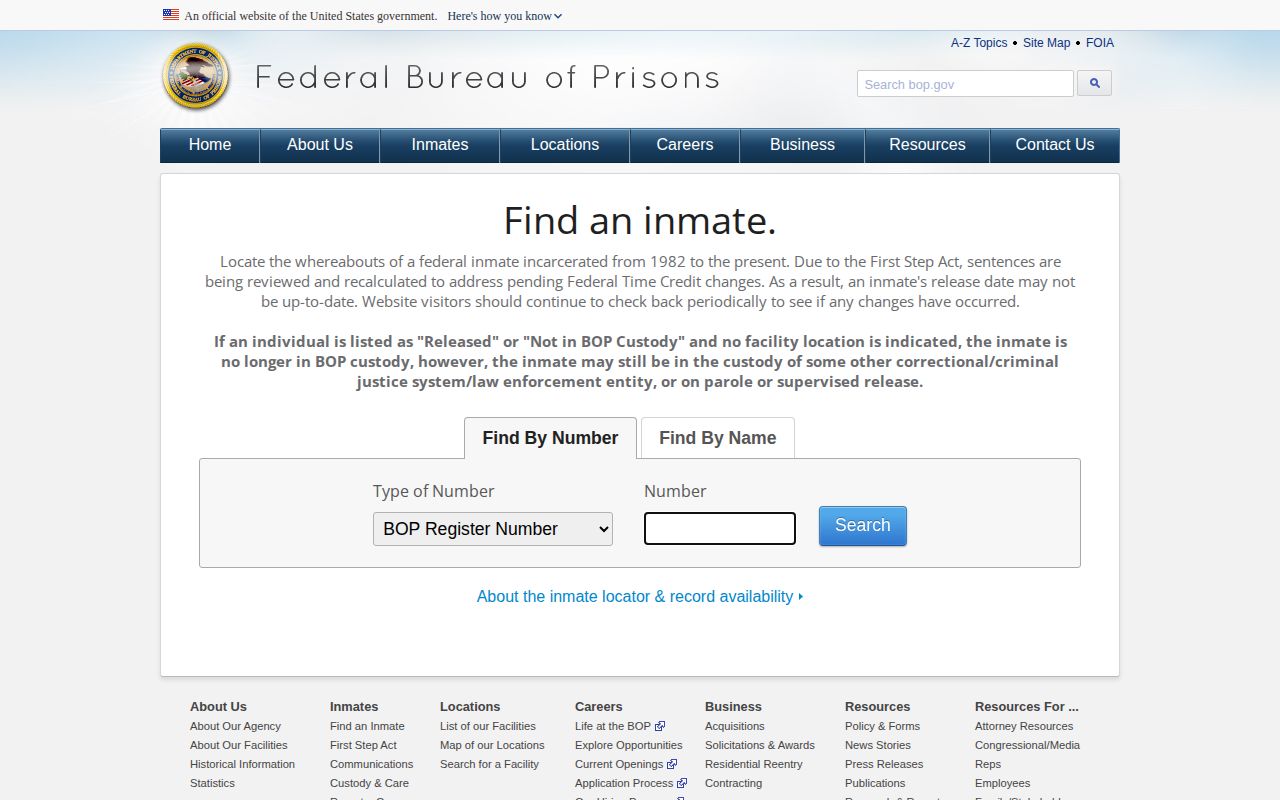
A person in federal pretrial custody may not yet be in the sentenced-prison database. Use the federal docket and responsible USMS district for that stage.
Was an Ottawa County Release an ICE Transfer?
A person can disappear from Ottawa's roster because another sovereign took custody. No reviewed official source established an ICE detention center or current ICE contract at Ottawa County Jail, so the site must not claim one. Where an immigration hold may exist, ask OCSO for the release disposition and any public receiving authority, then search ICE's Online Detainee Locator by A-number and country of birth or by the available biographical fields.
Very recent transfers and minors may not appear. A missing ICE result does not convert a possible transfer into a community release. Save a dated result when it is found and obtain case documentation promptly because locator visibility is limited.
Clean Slate and Ottawa County Release Records
Michigan's automatic Clean Slate process began April 11, 2023. Qualifying convictions can become nonpublic after the statutory periods, and court rules require set-aside conviction information to be removed from public release even though government nonpublic records may remain under MCL 780.623. An old copy or image on a nonofficial site is not stronger than the current court and agency source.
A public case or image that no longer appears does not prove the historical custody event never occurred. It means the current access rules and official record must be checked. Do not republish a sealed or set-aside detail from a stale mirror.
Ottawa County Released vs Current Custody
Each system answers a narrow question. Use the following comparison to avoid asking a live roster for a historical fact or using a prison database for a county-jail-only sentence.
| Source | What it can show | What it cannot prove alone |
|---|---|---|
| OCSO current lookup | Who is displayed in Ottawa County Jail custody now | Why an absent person left or when |
| OCSO release record | Booking-linked release time, disposition, authority, and public transfer detail | Every later event in another system |
| MiCOURT | Bond, disposition, sentence, jail credit, and later court orders | The precise physical processing time |
| OTIS | MDOC prison, parole, felony supervision, and recent discharge status | Jail-only custody or a later county rebooking |
| MI-VINE | Participating-agency custody events and notifications | A complete certified history |
| BOP or ICE locator | The relevant federal custody or release-locator status | Custody in every other sovereign system |
Getting Home After Ottawa County Jail Release
Harbor Transit began a two-year pilot serving the Ottawa County Fillmore Campus on July 1, 2026, with service scheduled through July 1, 2028. Rides are free through December 31, 2026. Riders schedule through the Lakeshore Go app or 616-842-3200, and the service is ADA accessible.
This is general public transit, not a jail-provided discharge ride. Service to the Fillmore Campus also does not mean a rider can travel to every destination in West Olive. Check current service boundaries and operating hours with Harbor Transit before relying on the trip.
Ottawa County Release Systems and Facilities
The Ottawa County Jail is the main adult local custody facility. Holland Department of Public Safety operates a short-term booking and lockup function, and jurisdiction may send a detainee to Ottawa or Allegan County. The Juvenile Detention Center uses protected juvenile-court channels and must never be treated as a public adult roster.
No operating MDOC prison, BOP institution, or ICE detention center was identified inside Ottawa County. Those statewide or federal systems still matter when an Ottawa case leads to state prison, federal custody, or an agency transfer. Community supervision offices are service locations, not detention sites.
- Ottawa County Jail handles adult county custody and OCSO booking/release records.
- Holland Department of Public Safety Booking/Lockup Facility provides municipal short-term processing.
- Ottawa County Juvenile Detention Center is a protected juvenile-court facility.
- MDOC prison system covers state sentences, parole, and discharge through OTIS.
- MDOC Grand Haven and Holland-area field offices supervise assigned state cases.
- Federal Bureau of Prisons system supplies the sentenced-federal locator path.
- ICE detention network supplies the immigration-custody locator path.
Public Record Search
Sponsored Results