
No Ottawa 72-Hour Release Archive
No official Ottawa County Sheriff page lists releases from the last 72 hours. The county inmate lookup shows only people currently in custody. Its search requires a complete last name and accepts optional first name, booking date, and gender. It warns that information changes quickly and does not promise a fixed refresh interval. There is no released-status filter, public three-day retention period, release-time field, or release-reason field.
This absence finding is central. A commercial booking site cannot be relabeled as an Ottawa County release source. Nor can three daily searches be treated as a complete county list. A person may never have appeared because of spelling, timing, or a different custodian. Someone who disappears may have gone home, entered MDOC, moved to another county, or transferred under federal authority.
Build Ottawa's Three-Day Window
Set a precise start and end time before searching. A 72-hour window is a moving period, while "the last three calendar days" is different. Use one definition throughout the inquiry and state the time zone. The sheriff's underlying record, not the current website, is the source that may identify departures within that interval.
- Search the current Ottawa roster and record the search time. A match means the person is displayed as in custody at that point.
- Check the exact person in VINELink for a transmitted custody event. Preserve the wording and event time.
- Review MiCOURT entries dated within and just before the window for bond, dismissal, sentence, or transfer context.
- Ask OCSO for booking and release records whose release timestamp falls within the stated interval. Supply a name or booking identifier when the inquiry is person-specific.
- Check OTIS, BOP, or ICE when facts point to a transfer. Do not call a receiving-custody event a community release.
This method is designed for reconstruction after time has passed. The Ottawa 24-hour release check is more focused on same-day verification and immediate transport or bond context.
Ottawa 72-Hour Record Fields
Ottawa does not display release-list columns online. Ask for existing jail-management fields that can be sorted or reviewed against the three-day period. The sheriff may apply lawful exemptions or redactions, and field names depend on the system that produced the record.
| Field | Use in a 72-hour review |
|---|---|
| Full booked name and booking number | Connects the departure to the correct custody episode |
| Admission date and time | Separates the booking from earlier or later stays |
| Release date and time | Places the event inside or outside the chosen window |
| Release disposition or reason | Distinguishes bond, sentence completion, court order, and transfer |
| Release authority | Identifies the agency or court behind the event |
| Transfer destination, if public | Shows possible continued custody under another authority |
A court entry can support the legal reason, but it may not state when jail staff completed physical release. Conversely, a VINELink event is useful contemporaneous corroboration but is not a certified historical ledger. Reconcile the sources by time and scope.
Ottawa Weekend Release Evidence
A three-day window often crosses a weekend or holiday. That can make a wider look practical, but the research found no official Ottawa promise that a release scheduled for a weekend is moved to Friday or handled by any fixed alternative rule. Processing can be affected by court orders, bond terms, holds, transport, and data transmission. Do not estimate a physical release from a sentence date alone.
Use the same evidence regardless of the day. The jail timestamp establishes when Ottawa processing ended. A court docket may show the order. VINELink may show when the custody event was transmitted. If the person was sentenced to MDOC, OTIS may appear only after state intake. Those timestamps can differ without being inconsistent.
- Rolling 72 hours
- The exact preceding three-day period measured from a stated search time.
- Three calendar days
- Three named dates, which may cover more or less than 72 hours.
- Transfer
- A change of custodian rather than a return to the community.
- Release disposition
- The jail's recorded category for how its hold ended.
Note: Label each date by function, such as court ordered, jail released, transferred, paroled, or finally discharged.
Ottawa Current Roster Comparison
The official current-custody search documents the web limitation more clearly than a third-party release page could.
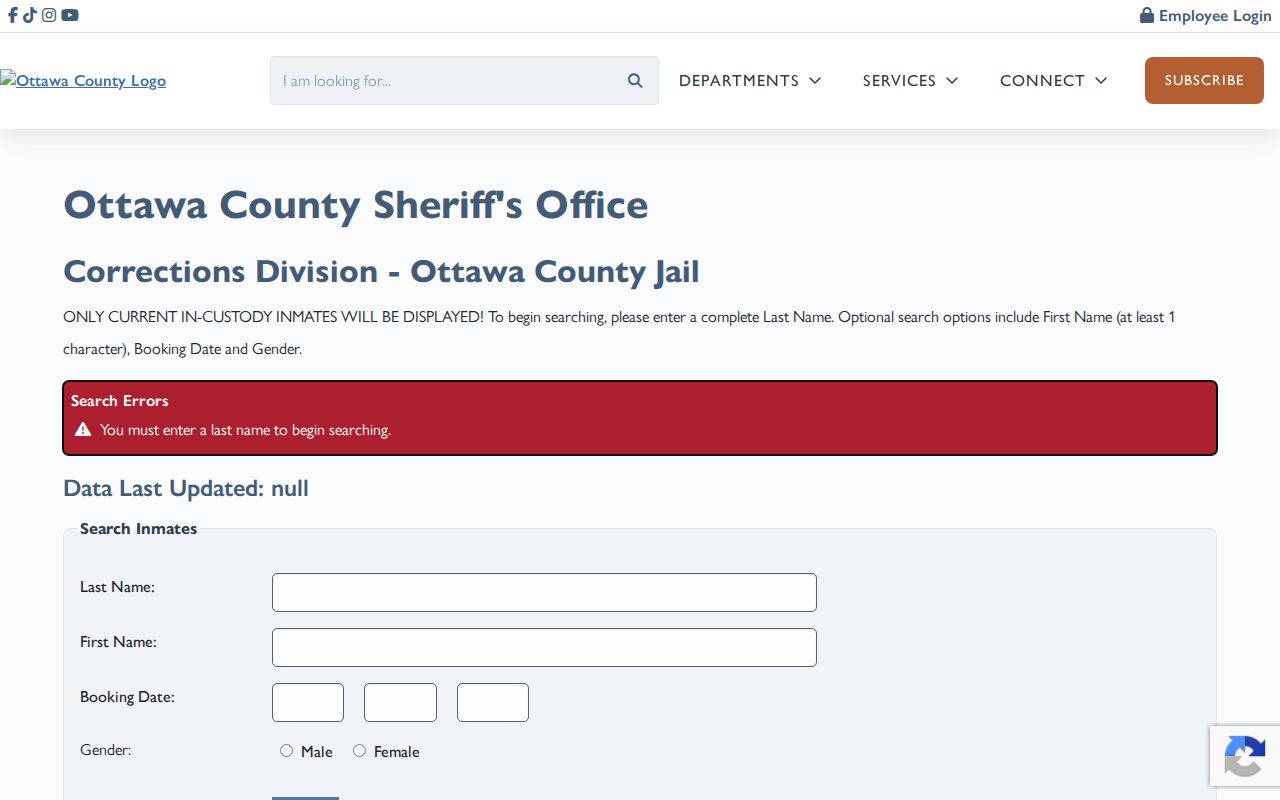
The screen shows the search fields and the current-only notice. It supplies a present comparison point, not the missing three-day history.
| Result | Supported conclusion | What remains unknown |
|---|---|---|
| Person appears | Displayed in Ottawa custody at the search time | Whether a future release is set |
| Person does not appear | Not displayed by the current search | Release, transfer, mismatch, timing, or no Ottawa booking |
| VINELink event appears | Agency transmitted the named custody event | Certified record fields or full court context |
| OCSO record states release | Ottawa's documented timestamp and disposition | Later custody outside Ottawa unless stated |
Request Ottawa Three-Day Releases
Ottawa encourages electronic requests through the FOIA Center. Written requests may also go by fax, mail, or in person to the Sheriff's Records Unit. Describe the date and time boundaries precisely. Ask for existing booking and release entries, not a newly created explanation. If the request is for one person, include the full booked name, booking number or date of birth if known, and approximate booking date.
OCSO states that reports are not produced at once for walk-in requests. Michigan FOIA provides a five-business-day response framework, with one possible ten-business-day extension. Permitted costs turn on actual work. Ask for an itemized estimate before labor-intensive work and set a cost ceiling if useful.
General Schedule 11 lists county-jail booking and control logs for calendar year plus seven years and daily count summaries for calendar year plus one. These are minimum retention rules for underlying records. They do not create a web archive or guarantee that every requested field is public.
Route Ottawa Departures by Custodian
An Ottawa County Jail departure can lead to the community, MDOC, another county, federal custody, or immigration custody. Start with the release disposition. If a prison sentence caused transfer, search the MDOC OTIS application after intake. OTIS does not contain jail-only cases. A paroled result means the person left prison but remains under MDOC supervision; final discharge means MDOC jurisdiction ended.
For federal sentenced custody, use the BOP locator. Federal pretrial custody may require the federal docket or USMS. For a possible immigration transfer, use ICE's Online Detainee Locator. None of those sources turns Ottawa roster absence into proof. They answer whether another system received or later displayed the person.
For a named-person investigation across all of these systems, use the Ottawa County release search. Keep the three-day list inquiry limited to the specified window and do not merge unrelated custody episodes.
Preserve Ottawa Release Proof
Save the official URL, the search or event time, and the exact status wording. A screen that says only "not found" has weak evidentiary value. A sheriff record stating the booking, release timestamp, disposition, and receiving authority is much stronger. If systems disagree, compare when each updated and which custodian each one covers.
Older records follow different paths. The current roster has no release archive. OTIS generally displays discharged MDOC records for three years after supervision discharge, subject to statutory exceptions. Court records may remain after those public locator windows end. A focused records request made promptly is the soundest way to preserve Ottawa County's three-day release evidence.
Rank Ottawa Three-Day Sources
Not every source carries the same weight. A sheriff booking and release entry that names the booking, release time, disposition, and receiving authority is the strongest ordinary public evidence of an Ottawa jail departure. A VINELink event is useful, prompt corroboration. The court order explains legal authority. A missing roster result remains only the first clue.
For a state-prison departure, OTIS Date Paroled or a supervision discharge date is stronger than Earliest Release Date, which marks eligibility. For federal custody, a BOP row showing released and a date can be useful but does not rule out another system or federal supervision. Compare the scope of each record before combining the timeline.
Use identifiers as well as dates. A full name, date of birth, booking number, MDOC number, or case number helps distinguish separate people and separate custody episodes. If the match remains uncertain, state that limit rather than assigning the event to the wrong person.
Public Record Search
Sponsored Results