
Ottawa County Release Date Fields
The Michigan Department of Corrections does not label its minimum-side date “projected release date.” OTIS uses Earliest Release Date. MDOC explains that this date comes from the court’s Judgment of Sentence and marks when the Parole Board gains jurisdiction. It is an eligibility marker, not a scheduled departure. Actual prison release can occur then or later, up to the lawful maximum.
Maximum Discharge Date is the outer date on the controlling sentence, subject to lawful computation. It can also be the date a person leaves prison when parole was never granted. Date Paroled is stronger evidence of an actual prison departure. MDOC defines it as the date the person left prison or camp, or the date parole status was conferred if the person was already in another non-secure status. A later supervision discharge date marks the end of MDOC jurisdiction.
| OTIS field | What it means | What it does not prove |
|---|---|---|
| Earliest Release Date | Minimum-side parole eligibility point | That release will happen on that date |
| Maximum Discharge Date | Outer sentence date under the controlling term | That parole will happen earlier |
| Date Paroled | Actual start of parole status | That supervision has ended |
| Supervision discharge | End of MDOC jurisdiction | That no later custody event exists |
Lookup Ottawa County Prison Dates
Use OTIS for a person committed to MDOC from Ottawa County. It is a statewide offender system, not a county jail roster. Search by MDOC number when available. A name search needs supporting identifiers. Once the record opens, read Current Status, Assigned Location, sentence details, Earliest Release Date, Maximum Discharge Date, and Date Paroled together.
- Confirm that the person entered MDOC custody, rather than serving a jail-only sentence.
- Search by MDOC number or carefully matched name and identity details.
- Open every relevant sentence row and note whether terms run concurrently or consecutively.
- Separate Earliest Release Date from Date Paroled and any supervision discharge entry.
- Compare the dates with the Ottawa sentencing-court record and current status.
- If a field appears wrong, route a court-derived issue to the sentencing court and a supervision issue to the assigned office.
The official OTIS scope page states that county-jail-only cases are excluded. It generally displays discharged prisoners, parolees, and probationers for three years after supervision discharge, subject to exceptions. An older absent record may require MDOC records or archival channels.
The state’s OTIS scope screen shows why an Ottawa County prison release-date search must remain separate from the county jail lookup.
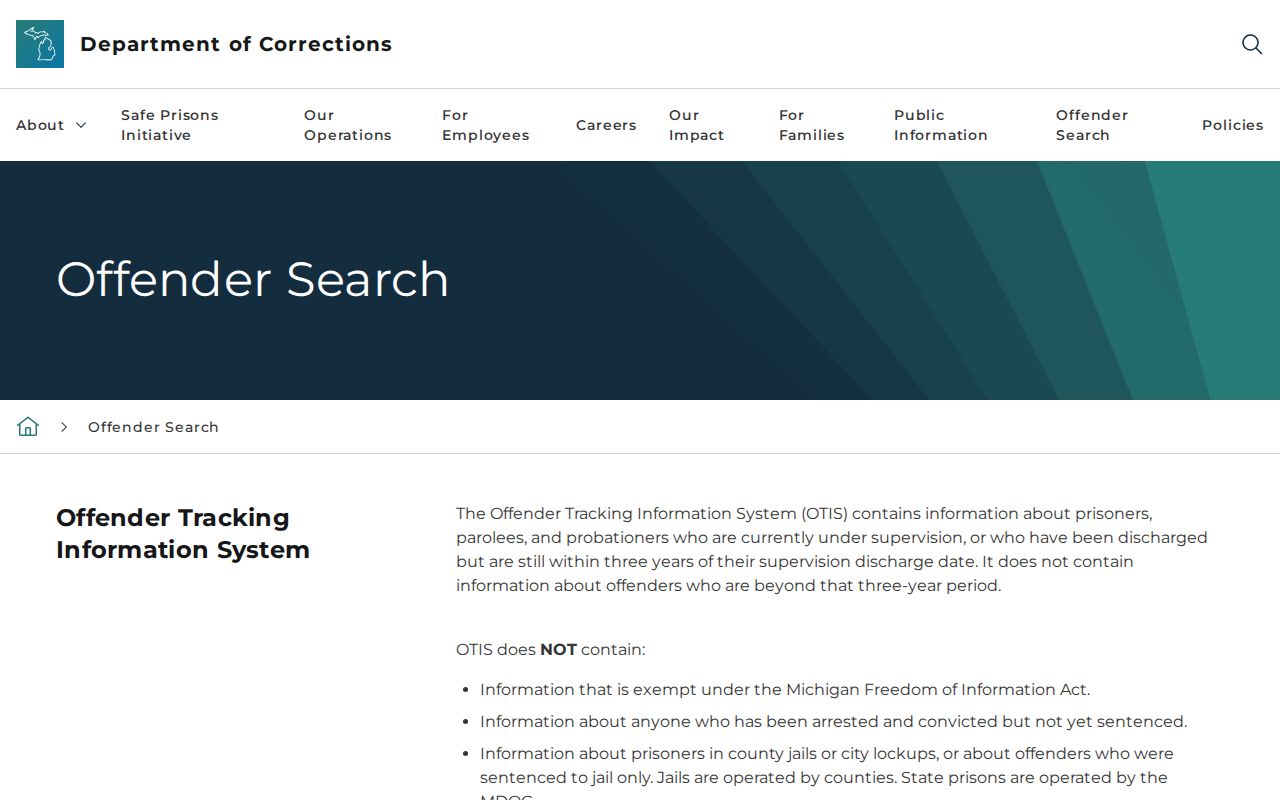
This boundary decides which date rules apply. A jail record cannot be estimated from an OTIS formula, and an MDOC prison term cannot be confirmed from the Ottawa live roster.
Ottawa County Truth-in-Sentencing Dates
Michigan truth-in-sentencing rules control many current state-prison terms. The MDOC truth-in-sentencing explanation says the law applies to specified assaultive crimes committed on or after December 15, 1998, and other crimes committed on or after December 15, 2000. A covered prisoner cannot use good time or disciplinary credits to reduce the court-imposed minimum. The full minimum must be served in prison before parole consideration.
There is no general Michigan 85-percent rule. Applying that shorthand to a Michigan sentence can create a false date. For covered state terms, the operative rule is 100 percent of the minimum before eligibility. Eligibility still does not compel the Parole Board to grant release. MCL 791.234 governs parole jurisdiction, including how applicable consecutive terms are aggregated.
Class 1 misconduct can produce disciplinary time considered by the Board. MDOC describes this as part of the parole decision process, not as a simple number mechanically added to the printed minimum. Court changes, corrected jail credit, new cases, detainers, and sentence interpretation can also alter the path.
The official Michigan truth-in-sentencing page illustrates the date and minimum-term rules used in this Ottawa County release-date inquiry.
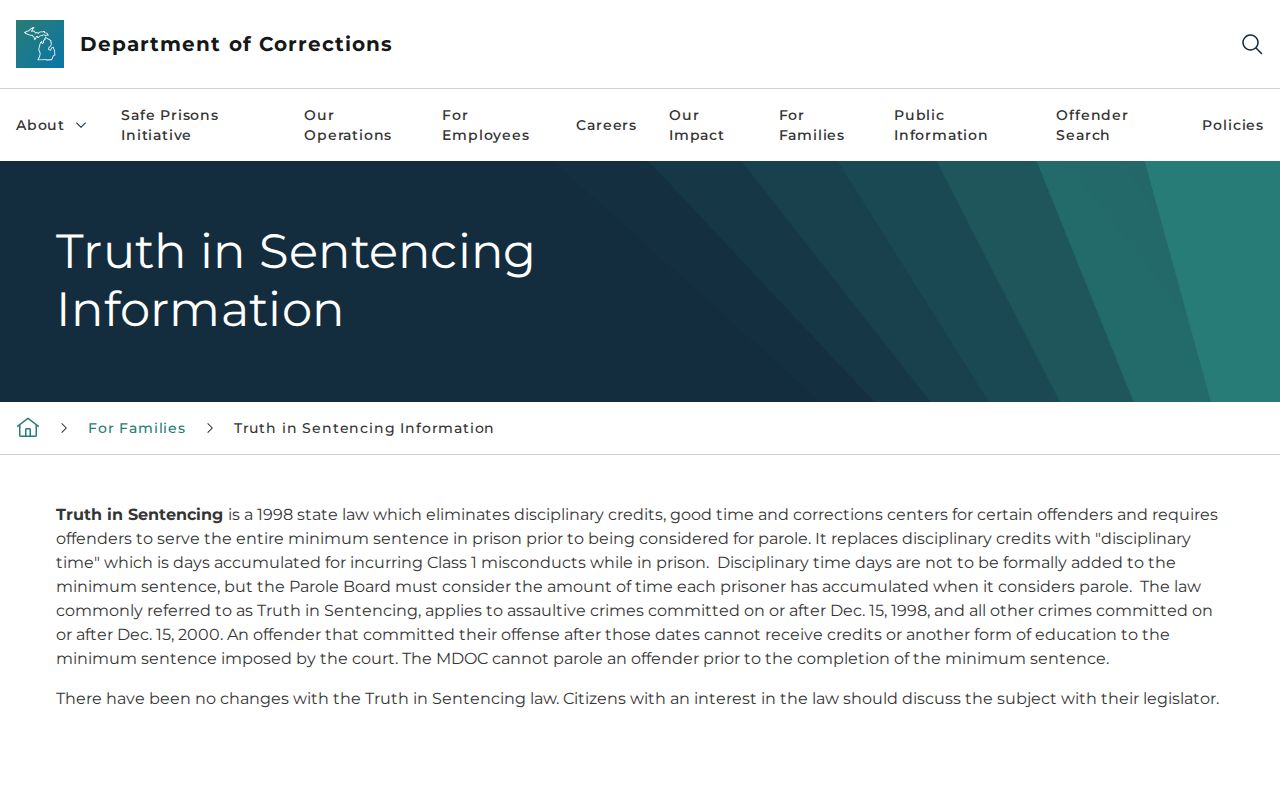
The screen is a rule reference, not a calculator. The judgment and person-specific OTIS record still control the practical lookup.
Ottawa County Legacy Sentence Credits
Offense date is critical for older Michigan prison sentences. Some prisoners remain eligible for legacy good-time or disciplinary credits under laws that predate current truth-in-sentencing coverage. MDOC’s glossary describes disciplinary credits as five days per month plus as many as two extra days for exceptionally good behavior. A major misconduct can cost those seven days, and the stated annual maximum reduction is 84 days.
Those figures must not be copied onto a truth-in-sentencing term. MCL 800.33 and related provisions contain the legacy framework. The correct analysis begins with the crime date, judgment, applicable statute, and MDOC computation. A printed maximum date can reflect lawful credit rules, but a reader should not reverse-engineer a person’s release from a general table.
Ottawa County Jail Has No Calculator
A jail-only sentence uses a different chain. Start with the court’s commitment order, the sentence imposed, and awarded jail credit. Michigan county-jail good-behavior provisions, including MCL 51.282, recognize local rules and posted allowances. The reviewed Ottawa County public pages do not publish a county release-date calculator or a county-specific allowance schedule.
That absence makes the jail’s actual computation and release record essential. The public Ottawa roster shows only current in-custody people. Once someone leaves, the row disappears and supplies no date or reason. A missing result can also reflect transfer, data timing, or a search mismatch. It should never be converted into an estimated release timestamp.
Bond, dismissal, and transfer are not sentence-credit calculations. Bond release can occur after all holds and conditions are satisfied. A transfer ends Ottawa County Jail custody but continues confinement elsewhere. No official Ottawa rule was found promising an early Friday release when a calculated date falls on a weekend or holiday. Processing may be affected, but a fixed adjustment must not be invented.
| Ottawa custody event | Best date source |
|---|---|
| Jail sentence completion | Court commitment, jail credit, and OCSO computation/release record |
| Bond or court-ordered release | Jail release timestamp plus the court order or bond entry |
| Transfer to MDOC | OCSO transfer disposition, then OTIS intake record |
| MDOC parole | OTIS Date Paroled and Current Status |
Request Ottawa County Release Dates
For a jail date, submit a focused request through the Ottawa County FOIA portal or the Sheriff’s Records Unit. Identify the full booked name, date of birth or booking number if known, and the admission range. Ask for the booking date and time, release date and time, release disposition, release authority, and public transfer destination. That phrasing seeks existing fields rather than asking the sheriff to create a forecast.
OCSO states that FOIA provides five business days for a response. The response can invoke one ten-business-day extension or provide payment instructions. Actual work controls the cost. Many requests may cost under $10, but that is not a promise for a particular record and OCSO says it cannot estimate a request by phone. The Records Unit is at 12220 Fillmore Street, West Olive, MI 49460; criminal reports and FOIA questions use 616-738-4025 or 616-738-4094.
For state records, current prisoner requests use Corr_Records_Info@michigan.gov. Past prisoner records up to six years post-release use MDOC-Records_Retention@michigan.gov. An MDOC public request can seek a particular releasable date or discharge certificate. A PENPACK contains a broader correctional record set but is restricted to recognized criminal-justice authorities for official business.
The Ottawa court record supplies another necessary layer. Misdemeanors and the early stages of felonies begin in 58th District Court, while felony adjudication and sentencing move to 20th Circuit Court. Search MiCOURT by case number or participant, then read the judgment, jail-credit award, and later orders. An online docket summary may explain the legal date but does not establish the physical moment OCSO completed release processing. Obtain the official order from the clerk when an abbreviation or missing document leaves the sentence unclear.
Why Ottawa County Dates Change
A release estimate can change because the underlying legal or custody facts change. Court amendments may alter the sentence. Corrected jail credit can move a computation. Consecutive and concurrent terms can be interpreted or corrected. A new case or another agency’s detainer can prevent community release even after one term is satisfied. Misconduct and parole decisions affect the MDOC path.
A positive parole decision is still not the departure event. MDOC can suspend parole action before release due to misconduct or adverse information. The reliable after-the-fact check is Current Status with Date Paroled. If the person served to the maximum without parole, Maximum Discharge Date may instead mark the prison exit.
- Eligibility
- The point when the Parole Board can act, not a promise of release.
- Parole
- Release from prison while MDOC supervision continues.
- Discharge
- The end of MDOC jurisdiction or a probation term.
- Detainer
- A request or basis for another authority to take or continue custody.
- Jail credit
- Time the sentencing court credits toward the imposed term.
When sources disagree, compare their timestamps and scope. A court order, jail processing record, VINE event, and OTIS update may describe different stages of one custody change. Preserve the sequence. The Ottawa County post-release supervision page explains how to confirm what follows a prison departure.
Identity errors can also create a false date conflict. Ottawa warns that a name match does not establish identity and that fingerprint comparison is definitive. Match the booking number, MDOC number, date of birth, and court case when those fields are available. If OTIS contains a court-derived error, MDOC directs the correction request first to the sentencing court. A disputed parole or assigned-office field should go to the supervising agent. Ask the record owner to correct the exact field instead of choosing the date that best fits an expected result.