
MDOC Ottawa County Prison Scope
Ottawa County’s 20th Circuit Court can commit a person to MDOC, but MDOC decides the prison assignment based on security, capacity, health, and programming needs. The person may be housed anywhere in the state system. MDOC does not announce a transfer in advance. After intake, the public OTIS record should update with the institution or assigned location.
No state prison physically operating in Ottawa County was found in the official directory reviewed for the research. “MDOC serving Ottawa County” therefore refers to a statewide system handling people sentenced by Ottawa courts. The Ottawa County Jail may hold the person before transfer, but its record ends at the county transfer-out. It does not become the state prison record.
Confirm an MDOC Prison Release
Use the OTIS search application for an individual state-prison record. An MDOC number is the best key. A name search needs corroborating facts because similar names can identify different people. Open the matched record and read Current Status, location, sentence dates, and supervision information together.
- Confirm through the Ottawa court judgment that the sentence was to MDOC.
- Search OTIS with the MDOC number, or use the full name and matching identity data.
- Read the institution or Assigned Location to learn where MDOC reports the person.
- Use Date Paroled as the main public marker that parole status began.
- Use supervision discharge date or reason to confirm the later end of MDOC jurisdiction.
- Check the county roster separately if a later Ottawa County booking is possible.
The state’s OTIS search screen is the correct entry point for Ottawa County state-prison releases.
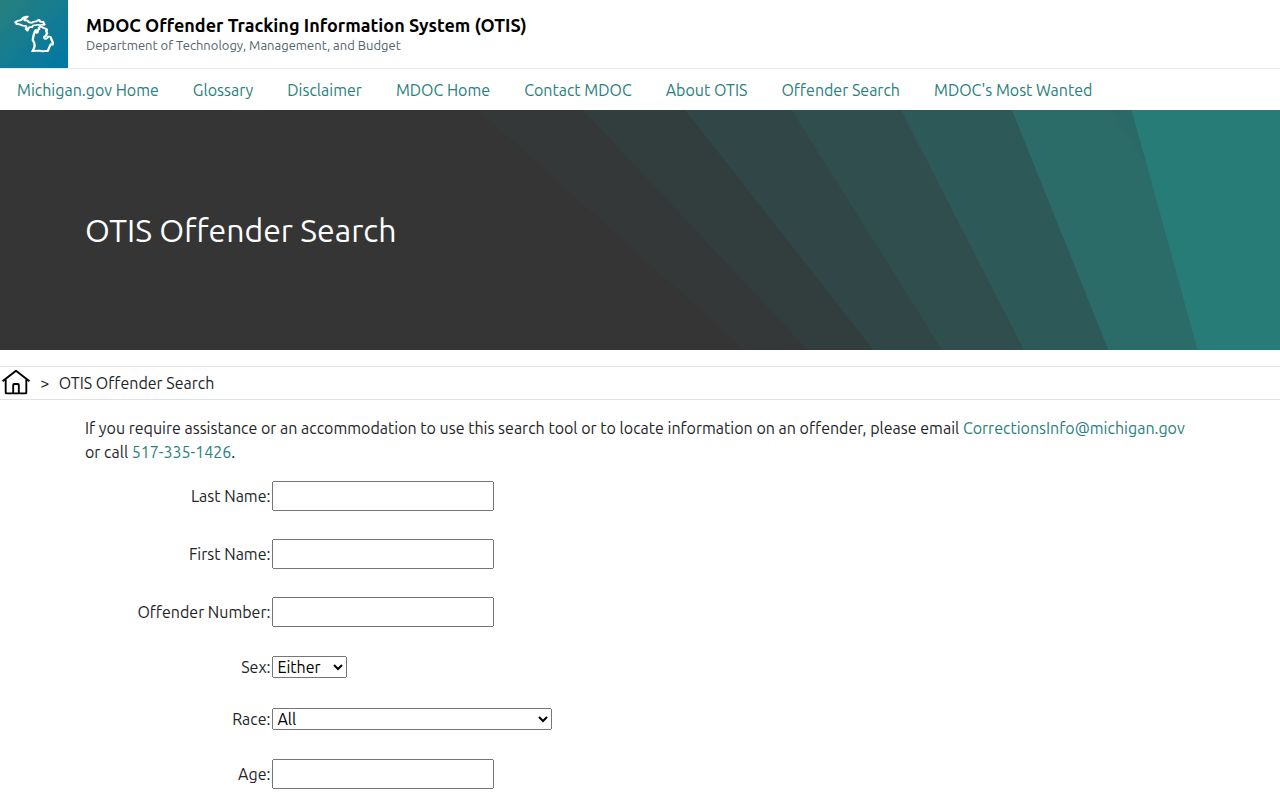
A search result must still be interpreted by status and date. A prison location shows custody; a parole location shows community supervision; a discharge entry shows that MDOC jurisdiction ended.
MDOC Ottawa Release Date Fields
OTIS uses specific date labels. Earliest Release Date is the point at which the Parole Board can gain jurisdiction after the applicable minimum. It is not a promised exit date. Maximum Discharge Date is the outer date on the controlling term, subject to lawful computation. Date Paroled is the actual date parole status began and is stronger proof that the person left prison.
Parole is not final discharge. A paroled person remains under MDOC conditions and supervision. The later supervision discharge date or reason records the end of state correctional jurisdiction. If parole never occurs, the maximum date can be the prison departure date. The Ottawa County release-date lookup provides the full truth-in-sentencing and jail computation distinction.
| MDOC status or date | Practical meaning |
|---|---|
| Prisoner / institution | Still in MDOC institutional custody |
| Earliest Release Date | Eligibility marker, not scheduled release |
| Date Paroled | Parole status began and prison departure occurred |
| Assigned Location | Community supervision office or unit |
| Supervision discharge | MDOC jurisdiction ended |
MDOC Ottawa Truth-in-Sentencing Rules
Michigan’s truth-in-sentencing information applies to specified assaultive crimes committed on or after December 15, 1998 and other crimes committed on or after December 15, 2000. Covered prisoners must serve 100 percent of the court-imposed minimum before parole consideration. Good time or disciplinary credits do not reduce that minimum.
Michigan has no general 85-percent rule for these sentences. Older offense dates may fall under legacy good-time or disciplinary-credit laws, which must be analyzed separately. Consecutive sentences can require terms to be aggregated under MCL 791.234. The offense date, judgment, sentence structure, and official MDOC computation control.
A favorable parole decision also is not the same as departure. MDOC can suspend parole action for misconduct or adverse information before release. Confirm the final event through Current Status and Date Paroled.
MDOC Ottawa OTIS Display Limits
The OTIS scope page says the system includes current prisoners, parolees, and probationers under MDOC jurisdiction. Discharged people generally remain public for three years after supervision discharge, subject to statutory exceptions. It excludes county-jail-only sentences, people not yet sentenced to MDOC, and records outside its public scope.
The manifest screenshot records these boundaries for an Ottawa County MDOC search.
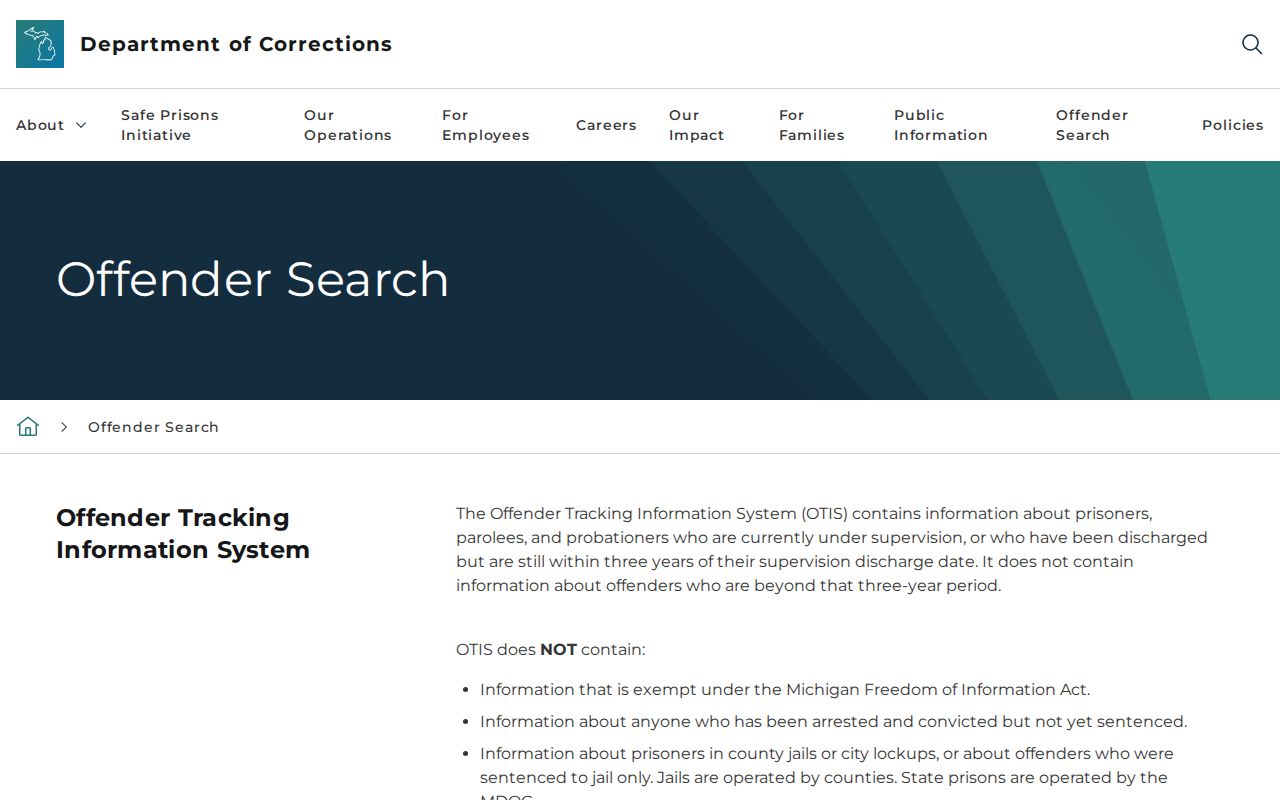
A missing result can reflect the display window, set-aside action, spelling, or lack of MDOC jurisdiction. It does not establish that a person was never in prison. Older records may require the MDOC retention office or Archives of Michigan.
MDOC Ottawa Parole Offices
After parole, OTIS may show a community supervision location. Ottawa-area MDOC field offices include Grand Haven, Hudsonville, and Holland. Always use Assigned Location from the current record. The closest office may not hold the case.
Grand Haven
County Building, Room G0001
414 Washington Street
Grand Haven, MI 49417-1473
616-846-8217
Hudsonville
3100 Port Sheldon Road
Hudsonville, MI 49426-9018
616-662-6075
Holland
12185 James Street, Suite 150
Holland, MI 49424-9661
616-392-5442
These offices supervise community cases. They are not prisons and do not operate a county release roster. The Ottawa County supervision page also explains the separate 58th District Court probation channel.
Request MDOC Ottawa Release Records
OTIS is an informational public record. When a formal or older document is needed, use MDOC’s records channels. Current prisoner records can be requested at Corr_Records_Info@michigan.gov. Past prisoner records up to six years post-release use MDOC-Records_Retention@michigan.gov. Public records requests use MDOC-FOIA@michigan.gov or the MDOC FOIA page.
Michigan Department of Corrections
Grandview Plaza
206 East Michigan Avenue
P.O. Box 30003
Lansing, MI 48909
517-335-1426
Monday–Friday, 8:00 a.m.–5:00 p.m. Eastern
Request the exact releasable document, such as a discharge certificate or date field. MDOC says a PENPACK can include a presentence report, basic information sheet, parole eligibility report, photo if available, fingerprints, judgment, and discharge certificate, but that package is restricted to a recognized criminal-justice authority for official business. A public requester should not claim entitlement to it.
For a record error, identify the source field. MDOC says most court-derived OTIS errors should first go to the sentencing court. A supervision item, such as assigned location or absconder status, should go to the assigned parole or probation office. General inaccuracies may be reported to CorrectionsInfo@michigan.gov. Preserve the original record and the agency response so the corrected timeline remains clear.
Ottawa Jail to MDOC Transfer
A person can disappear from the Ottawa County Jail roster because the county transferred them to MDOC after a prison sentence. That is continuous custody, not release to the community. The OCSO booking/release record should describe the county disposition or receiving authority, and OTIS should become the public locator after state intake.
Updates may not occur at the same moment. During the gap, the safest statement is that Ottawa no longer displays the person. Check the sentencing judgment, ask OCSO for the transfer disposition, and search OTIS again after intake processing. A VINE custody-change event can corroborate timing but is not a certified state discharge record.
The related court path also matters. Ottawa felony matters begin in 58th District Court and move to 20th Circuit Court after preliminary examination or waiver. The circuit judgment can show the prison commitment, while OCSO documents the county’s physical transfer and MDOC documents state intake. These records describe consecutive stages, not competing answers. Align their dates before labeling the custody change.
- Transfer
- Movement from one custodian to another without community release.
- Parole
- Departure from prison while MDOC supervision continues.
- Discharge
- The end of MDOC jurisdiction.
- Assigned Location
- The institution, office, or unit shown in the state record.
Michigan’s public system generally keeps a discharged offender visible for three years after supervision discharge, subject to set-aside and other statutory limits. MDOC also provides a past-prisoner records channel for up to six years post-release. Once those windows no longer help, an older Ottawa sentence may require court records or archival research. Public absence should be described as a limit of the current source.